 |
| Image Source: theguardian.com |
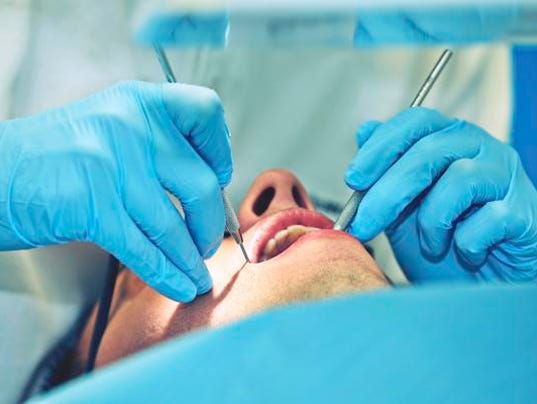
Home dental treatment. Picture posed by a model.
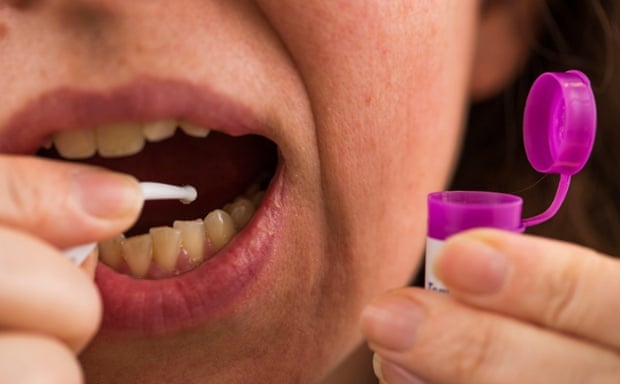
A missed appointment and resulting £25 charge led Alex to become a DIY dentist. Using an emergency over-the-counter dental first aid kit, bought from a pound store, the 38-year-old building engineer from Glasgow began fixing his own teeth rather than run up bills. “I couldn’t justify going and getting my teeth out when we can’t afford nappies,” he said.
His partner, Tilly, gave up her teaching job when their eldest son was diagnosed with leukaemia five years ago. When the recession hit, Alex found work hard to come by. A jobcentre interview clashed with an appointment to fill some cavities, and Alex concluded that the family could not afford his dental work.
In a country that prides itself on free healthcare, DIY dentistry is an almost Victorian notion of hardship. But poverty and inequality – and the increasing stigma attached to both – are blocking access to healthcare for the poorest people in the UK, and grim tales of a black economy are on the rise.
“DIY dentistry is fairly common round here,” said Emma Richardson at the Star Project in Paisley, Renfrewshire. “They sell a lot of those first aid kits – you can buy them in Boots and Asda as well, and you’ve got people taking care of their whole family’s teeth with them.” The kits, which can be bought for a few pounds, are intended as a temporary remedy for lost fillings, caps and crowns.
In a survey of local people, the Star Project, a church-based community organisation, found people buying DIY kits online from pound shops or even from friends to do their own fillings. One client told Richardson: “My uncle takes care of his teeth and everyone in his family.”
The project also found people trading unfinished courses of sedatives, anti-depressants, beta blockers and antibiotics. “There’s a mixture of reasons,” said Richardson. “Some people only have pay-as-you-go phones – if they run out of money, they can’t make calls. They have to wait until the community centre is open at 9.30am to use the phone, by which time it’s too late to book a [doctor’s] appointment. Or they feel embarrassed to fill out the form [for free dental treatment] and prefer to get help from friends who don’t judge them as scroungers. People will maybe take half a course of a drug and keep some of them in case something comes back. If one of the neighbours or friends needs them, they’ll help out.”
Accurate figures on the extent of DIY dentistry are hard to find. One of the biggest seller of dental first aid packages, DenTek, shifts more than 250,000 kits a year, but there is no research on how they are used. In 2012, research from the oral health charity, the British Dental Health Foundation, found that one in five Britons said they would remove a tooth themselves or ask a friend to do so if they could not afford dental treatment.
The Department of Health said reports of DIY dentistry were anecdotal. “Official figures show that more people than ever are getting NHS dental treatment, which is completely free for almost everyone receiving income-based benefits and subsidised for low earners,” said a spokesperson. However, according to NHS UK, people receiving incapacity benefit, contribution-based jobseeker’s allowance, contribution-based employment and support allowance, disability living allowance, council tax benefit and housing benefit, among others, are not entitled to free treatment without other qualifying benefits.
Figures, as opposed to anecdotal evidence, on DIY dentistry and the black health economy are elusive, said John Wildman, professor of health economics at Newcastle University, because health data is gathered by surveying patients or GP surgeries.
“People at the lower end of the distribution curve – on big housing estates in the north-east, for instance – are effectively completely unreported,” he said. “They don’t take part in surveys and they don’t go into GP surgeries. Which is why you have a situation where people in the north-east have gaps in their teeth and are resorting to DIY dentistry. There’s research from the US that shows poor teeth hinder your chances of getting a job and getting married – the two fundamentals for building a stable life.”
 |
| Image Source: theguardian.com |
Alice – one of the Star Project’s service users – resorted to popping an abscess with a fork because of worry about the costs of treatment. Dental examinations are free in Scotland and Northern Ireland, although charges are made for treatment. The cheapest, a filling, costs £7.20 with prices reaching a maximum of £384 for the most expensive treatments. In England and Wales, NHS dental examinations cost £18.50 and £13 respectively - which includes cheaper treatments - with mid-ranking treatments costing £50.50 and £42 respectively and the most expensive treatments costing £219 and £180.90 respectively.
“The majority of people would think these prices are relatively reasonable if you need work doing,” said Karen Coates, of the Dental Health Foundation. “It’s about prioritising £50. They probably would go and get their nails done or their hair, and don’t consider that the dentist is high enough on their need list, whereas for other people it is a priority to go regularly to the dentist.”
All the costs were unaffordable for Alice, whose partner had been sanctioned for arriving late at a jobcentre interview, leaving the couple with about £65 per week. Out of that, they paid £10 for gas and £10 for electricity, plus bus fares to the jobcentre. “When you add in TV licence and phone calls you’ve got £25 per week, which has to cover food,” she said.
Even an NHS dentist would have made a big hole in her meagre budget – assuming there is an NHS dentist in the area. According to Jack Toumba, professor of paediatric dentistry at Leeds University, oral health inequality is particularly bad because dentistry has in effecti been privatised. Although there are dental practices offering NHS care, they are increasingly hard to find.
“We’re finding patients who’ve rung practices across the north asking to register as an NHS patient only to be told the NHS lists are full and they can only register as a private patient,” he said.
He cites the case of a 40-year-old HGV driver who used the plastic mirror, forceps and probe from an over-the-counter dental kit to clean and prepare a cavity before plugging the hole withQuikSteel, a potentially toxic steel reinforced epoxy putty used to fix engines. “His local dentist had discontinued NHS dental services and he couldn’t afford private dental care or find another NHS dentist. He’d treated the tooth twice by himself in the three years before he came to see us.”
The imbalance in the UK’s oral health is stark. Research published in the Journal of Dental Research last autumn found that poorer Britons have, on average, eight fewer teeth – a quarter of a full adult set – than the richest by the time they reach their 70s.
Patricia Lucas, at Bristol University’s school for policy studies, said data from the city’s dental hospital showed children from disadvantaged backgrounds were significantly more likely to have early tooth decay and to need teeth extracted under general anaesthetic. In 2013 – the most recent data available – 721 children had decaying teeth extracted under general anaesthetic, the majority from poorer wards in the city. Of those, 155 were below the age of five.
Now Dentaid, a dental charity which works to improve oral health in the developing world, is preparing to launch its first UK-based project. The organisation, which offers portable dental surgeries to struggling communities in Uganda, Malawi, Cambodia and Romania, is considering mobile surgeries in the UK, or working with existing practices to pay for transport and treatment.
“It’s extremely hard for the homeless, or people who haven’t got a permanent residence, or people coming out of prison to access dental treatment,” said Andy Evans, Dentaid’s strategy director. “Homeless people normally only turn up at a dentist when they are in extreme pain – when fillings or tooth extraction are needed. They don’t do regular visits to the doctor and the only painkiller they have is alcohol so sometimes they are in no good condition to be treated when they most need it.”
 |
| Image Source: theguardian.com |
Inclusion Healthcare is a Leicester-based social enterprise that cares for around 1,000 single homeless adults. One, Mary, struggled with addiction for years, fell out with her family, ended up on the streets and was forced into casual prostitution. By her mid-30s she had lost most of her teeth through being attacked, , falling and simply struggling to find somewhere to clean her teeth.
But as she rebuilt her life and her self-esteem, her ruined mouth damaged her chances of a job and of finding new relationships. Eventually, a Leicester dentist took her on and replaced all her teeth with dentures. The change is startling. She walks taller. She smiles with confidence.
“We don’t see teeth as being a crucial part of the health service,” said Wildman. “We see it as a luxury. But toothache stops kids sleeping and concentrating in school, a bad smile damages your chances of getting a job … and as it gets harder and harder for disadvantaged people to receive good dental care. The best way to resolve health inequality is to make social mobility possible - and someone’s smile is not a luxury add-on to that.”
Dr. Domenick Coletti leads a team of surgeons at the Central Maryland Oral and Maxillofacial Surgery P.A., serving patients with high-quality dental care treatments ranging from dental implant surgery and corrective jaw surgery to wisdom tooth extractions. Log on to this website to learn more about the Columbia, Maryland-based doctor.